
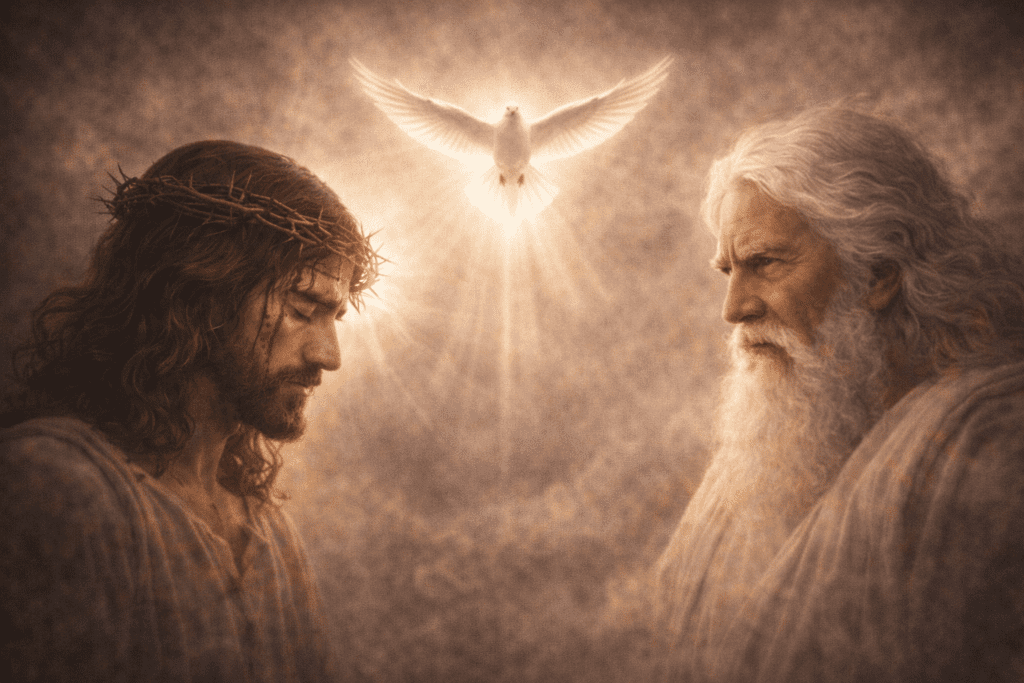
Short Answer: The Trinity is the Bible’s teaching that there is one God who eternally exists as three distinct persons—Father, Son, and Holy Spirit—each fully God, not three gods.
Long Answer: The Trinity is the Bible’s teaching that there is one God who eternally exists as three distinct persons—Father, Son, and Holy Spirit—each fully God, not three gods.
The word “Trinity” is not found in Scripture, but it’s a helpful summary of what the Bible clearly reveals about God. Christians didn’t create the Trinity to be confusing; they embraced it because the Bible teaches three truths that must be held together.
Three truths the Bible teaches
1) There is only one God
The Bible is strongly monotheistic: “The LORD is one” (Deuteronomy 6:4). Christianity does not teach three separate gods. There is one divine Being—one true God.
2) The Father, Son, and Holy Spirit are distinct
At Jesus’ baptism, the Father speaks, the Son is baptized, and the Spirit descends (Matthew 3:16–17). Jesus prays to the Father and promises to send the Spirit (John 14:16–17). This shows real personal distinction, not one person acting in three different roles.
3) Each person is fully God
Scripture calls Jesus divine and treats him as worthy of worship (John 1:1, 14; John 20:28). Scripture also speaks of the Holy Spirit in ways that belong to God—he acts personally, gives life, and can be lied to as God (Acts 5:3–4; Titus 3:5).
Where the Trinity shows up in Scripture
A few passages bring the three together in a striking way:
- Jesus commands baptism “in the name” (singular) of the Father, Son, and Holy Spirit (Matthew 28:19).
- Paul blesses the church with grace from Jesus, love from the Father, and fellowship of the Spirit (2 Corinthians 13:14).
These texts don’t lay out a full “Trinity definition,” but they show the early church speaking of Father, Son, and Spirit together as the one God’s saving work.
What the Trinity is (and what it isn’t)
The Trinity means:
- One God
- Three distinct persons
- Each person fully God
- Not three gods, not one person wearing three masks
The Trinity does not mean:
- God is one person who sometimes appears as Father, sometimes as Son, sometimes as Spirit
- The Father is “more God” than the Son or Spirit
- We can fully explain God like a simple math problem
We can know God truly, but we cannot reduce God to something we can completely control or picture.
Why the Trinity matters
The Trinity isn’t a side issue. It helps us understand the gospel:
- The Father sends the Son
- The Son becomes human, dies, and rises
- The Spirit applies salvation, gives new life, and empowers the church
If you remove the Trinity, you eventually distort who Jesus is, how salvation works, or how we relate to God.
What to do next
- Read Matthew 28:19 and Matthew 3:16–17 and note what they show about God.
- Read John 14–17 to see Jesus’ relationship with the Father and the Spirit.
- Worship with humility—God is one, and God is greater than our diagrams (Romans 11:33–36).
- If this feels confusing, start with what is clear: the Father loves, the Son saves, and the Spirit gives life.
The Trinity is not a puzzle to solve before you can follow Jesus. It’s a truth to receive because Scripture reveals God as Father, Son, and Holy Spirit.
Key Scriptures: Deut 6:4; Matt 28:19; Matt 3:16–17; John 14:16–17; John 1:1, 14; John 20:28; Acts 5:3–4; 2 Cor 13:14; Titus 3:5; Rom 11:33–36