
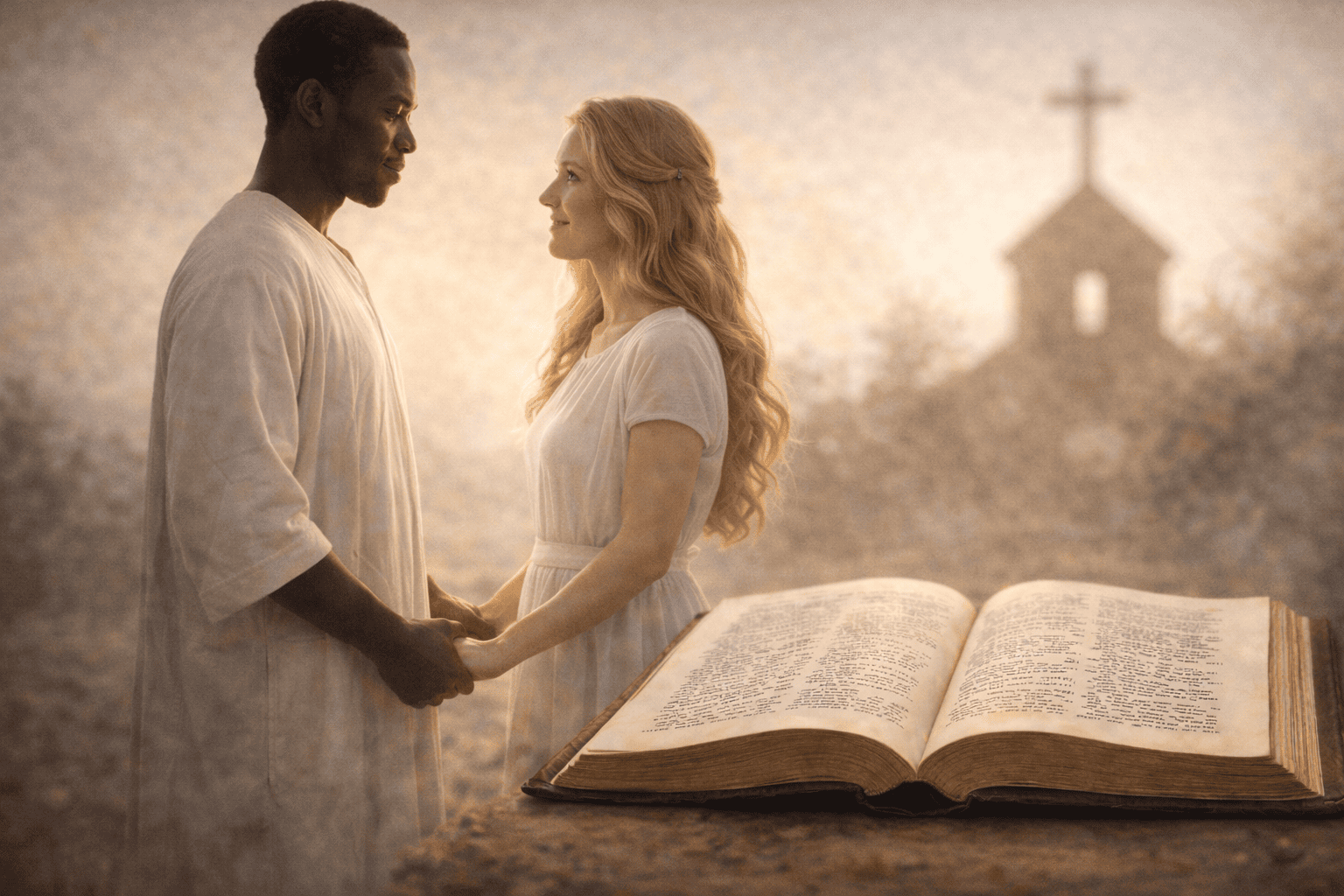
Yes. Scripture does not forbid marriage between people of different races or ethnicities; it calls believers to marry with faithfulness to the Lord at the center.
Many Christians wrestle with questions about culture, family expectations, and prejudice when they’re considering marriage. The Bible speaks to these concerns with both clarity and hope. Does the Bible allow interracial marriage? What does Scripture say about marrying someone of another race or ethnicity? When you trace the whole story of Scripture, you find that God’s concern is not skin color or ethnicity, but covenant faithfulness—whether a marriage will honor him and help two people follow him.
From the beginning, God made all humans in his image (Genesis 1:27). That means every person—every ethnicity, every nation—has real dignity and worth. The Bible also teaches that God is bringing together a redeemed people “from every nation” through Jesus (Revelation 7:9). So, when we think about marriage across ethnic lines, we shouldn’t start with fear. We should start with God’s design for humanity and God’s plan to unite people in Christ.
At the same time, Scripture is not naive about the dangers of relationships. The Bible’s strongest warnings about marriage are not about ethnicity. They’re about idolatry, divided allegiance, and spiritual compromise—the kind of bond that pulls your heart away from the Lord.
What the Old Testament warnings were really about
Some people point to Old Testament commands where Israel was told not to intermarry with certain surrounding nations (for example, Deuteronomy 7:3–4). If we read those verses quickly, it can sound like a ban based on ethnicity. But the text itself gives the reason: “for they would turn away your sons from following me, to serve other gods” (Deuteronomy 7:4). In other words, God was protecting his people from being absorbed into idol worship.
You see the same theme in Israel’s history. Solomon’s many marriages are described as spiritually devastating because “his wives turned away his heart after other gods” (1 Kings 11:1–4). The tragedy wasn’t a mismatch of ethnic backgrounds; it was a divided heart and a compromised devotion.
That’s important because it helps us avoid a serious mistake: using passages about idolatry to justify racial prejudice. Scripture does not give God’s people permission to despise or avoid someone because of their ethnicity. It warns God’s people not to unite their lives to someone who will lead them away from the Lord.
Scripture includes honorable cross-ethnic marriages
The Bible contains stories that positively feature marriages across ethnic or national lines—especially when faith in the true God is central.
One key example is Moses. Numbers 12 mentions that Moses had a Cushite wife, and Miriam and Aaron criticized him for it (Numbers 12:1). In that story, God rebukes their attitude and defends Moses (Numbers 12:5–10). The narrative does not treat Moses’ marriage as sinful because of ethnicity.
Another well-known example is Ruth, a Moabite woman who married Boaz, an Israelite (Ruth 4:13). Ruth’s story is honored, and she becomes part of the family line that leads to King David (Ruth 4:17). The New Testament later highlights Ruth in Jesus’ genealogy (Matthew 1:5). Rahab, a Canaanite woman, is also included there (Matthew 1:5). These details matter: God intentionally shows that his saving plan was never limited to one ethnic group.
Taken together, Scripture’s storyline points in a consistent direction: ethnicity is not a barrier to honoring God in marriage.
The New Testament emphasis: shared faith and new family in Christ
For Christians, the clearest guidance about choosing a spouse is spiritual. Paul teaches that a believer who marries should marry “only in the Lord” (1 Corinthians 7:39). That phrase is simple but deep: marriage is meant to be a covenant partnership where both people belong to Jesus and are committed to walking in his ways.
A related passage often discussed is 2 Corinthians 6:14 about not being “unequally yoked” with unbelievers. While the immediate context addresses partnerships and shared life commitments that compromise faith, marriage is certainly the closest life bond. Wisdom says: don’t tie your future to someone who rejects the Lord you love.
So the Bible’s main question for marriage is not, “Do we share the same ethnicity?” It’s more like:
- Do we share the same Savior?
- Do we share the same direction of life—toward Jesus?
- Will we help each other obey Christ when it’s hard?
When both spouses are believers, the gospel also creates a new kind of family identity. Scripture teaches that in Christ, old walls of hostility are torn down, and God forms “one new man” (one new humanity) through Jesus (Ephesians 2:14–16). This doesn’t erase cultures or backgrounds, but it does mean ethnic pride and racial contempt have no rightful place among God’s people.
A common misunderstanding to avoid
A common misunderstanding sounds like this: “The Bible prohibited Israel from marrying foreigners, so Christians shouldn’t marry across ethnic lines today.”
But that conclusion doesn’t match the Bible’s own reasoning. The Old Testament warnings were aimed at avoiding the worship of false gods (Deuteronomy 7:3–4). And Scripture repeatedly shows that when outsiders turned to the Lord, they were welcomed among God’s people (Ruth 1:16; Joshua 2). The dividing line was faithfulness, not skin color.
If someone uses the Bible to defend racism, they’re misusing Scripture. Racism contradicts the biblical truth that every person is made in God’s image (Genesis 1:27) and contradicts the gospel’s call to unity and love in Christ (John 13:34–35; Revelation 7:9).
Wise, practical counsel for cross-cultural couples
Even when a marriage is biblically permissible, it can still be challenging. Couples from different backgrounds may face real differences in communication style, family expectations, holiday traditions, language, or views of honor and conflict. None of those automatically spell trouble, but they do require humility and intentional love.
Here are some wise areas to talk through (preferably with mature believers and church leaders involved):
- Shared discipleship: How will you pray together, worship together, and grow together in Christ? (Colossians 3:16–17)
- Family dynamics: How will you honor parents without letting family pressure control your covenant? (Genesis 2:24; Ephesians 6:2)
- Handling prejudice: If relatives or friends show bias, how will you respond without bitterness, and without enabling sin? (Romans 12:18–21)
- Raising children: What will you teach your kids about identity, heritage, and belonging in Christ? (Deuteronomy 6:6–7; Ephesians 6:4)
- Conflict and forgiveness: Do you have patterns of repentance, listening, and reconciliation? (Ephesians 4:31–32)
Also, pay attention to your own heart. Sometimes people pursue a relationship across ethnic lines in a healthy way; other times they do it to rebel, to provoke, or to chase an image. Scripture calls us to examine motives and pursue love that is sincere and pure (1 Timothy 1:5).
What Scripture calls the church to model
Because this topic touches the wounds of racism and the beauty of unity, it’s not just an individual issue—it’s also a church issue. Jesus said his disciples would be known by love (John 13:35). That love isn’t abstract; it shows up in how we welcome one another, defend the dignity of others, and refuse to treat people as “less than.”
If a Christian couple is walking with Jesus, the church should respond with truth and tenderness—encouraging wise preparation for marriage, calling out sinful prejudice when it appears, and providing real community support. This is one of the ways the gospel becomes visible: a diverse family made one in Christ (Ephesians 2:14–16).
What to do next
- Pray for wisdom, courage, and a heart that honors Christ above culture or fear (James 1:5).
- If you’re dating, seek premarital counseling through a healthy local church; invite a pastor/elder or mature couple to help you ask the hard questions early (Proverbs 15:22).
- Talk openly about faith, family expectations, traditions, and how you’ll handle conflict and outside pressure with grace.
- If one of you is not yet a follower of Jesus, don’t rush toward marriage—start with the gospel: repent, confess Jesus as Lord, and be baptized by immersion for the forgiveness of sins, then learn to follow him in a local church community (Acts 2:38; Matthew 28:19–20).
- If you’ve faced racism or family hostility, ask your church leaders for prayer and help setting wise boundaries while pursuing peace when possible (Romans 12:18).
Genesis 1:27; Deuteronomy 7:3–4; Numbers 12:1–10; Ruth 4:13–17; Matthew 1:5; 1 Kings 11:1–4; 1 Corinthians 7:39; 2 Corinthians 6:14; Ephesians 2:14–16; Revelation 7:9
Memorize these passagesHear them read, say them back, and learn them by heart.
Also asked as
- Is interracial marriage a sin?
- What does the Bible say about marrying someone of a different race?
- Is it wrong to marry outside your race?
- Does the Bible forbid mixed marriages?
Part of the question Does the Bible talk about _________?