
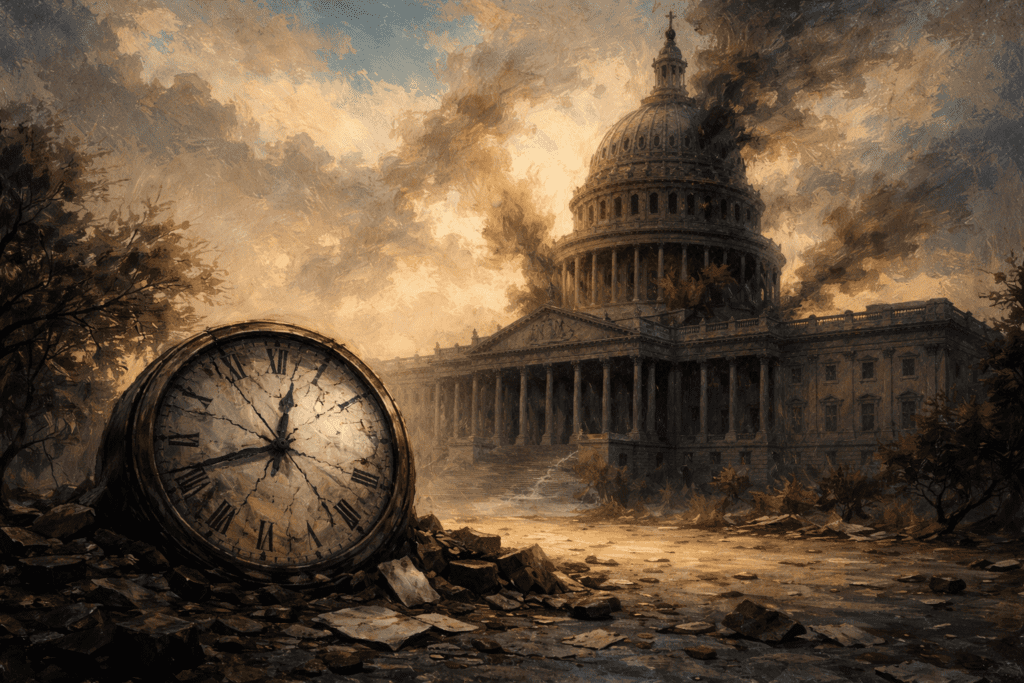
Short Answer: How should Christians think about political chaos (like a government shutdown)? With steady trust in God, prayer for leaders, gracious speech, and active love—because Jesus is King.
Long Answer: When public life feels unstable, it can stir fear, anger, and exhaustion. The Bible doesn’t ask Christians to ignore what’s happening or to withdraw into cynicism. It teaches us how to live faithfully in the middle of it: engaged without being consumed, concerned without despairing, and truthful without becoming harsh. Above all, we remember that Jesus reigns, and his kingdom cannot be shaken.
Is God still in control when governments seem unstable?
Yes. Scripture is clear that God’s authority is higher than every human authority. Daniel, one who served faithfully during extreme political turmoil for Israel, praises God because he “removes kings and sets up kings” (Daniel 2:21). That doesn’t mean every political decision is wise or righteous. It does mean political instability never catches God off guard.
This truth guards us from panic. Fear often whispers, If the system breaks, everything breaks. But the Lord is still our refuge (Psalm 46:1–2). Christians can grieve what is broken, work for what is good, and stay steady because God’s throne is not threatened by human conflict.
Where should a Christian’s ultimate loyalty belong?
Our deepest loyalty belongs to Jesus and his kingdom. The New Testament says our “citizenship is in heaven” (Philippians 3:20). That doesn’t make us indifferent about the place where we live; it puts our engagement in the right order.
Earthly governments matter, but they are not the gospel. No party platform equals God’s kingdom. No election outcome can replace repentance and new life in Christ. When Christians confuse politics with salvation, we end up either arrogant when “our side” wins or crushed when it loses. When we keep Christ at the center, we can serve our neighbors with clarity and calm.
What does the Bible call Christians to do for leaders during turmoil?
The Bible calls us to pray—especially when things are tense. Paul urges “supplications, prayers, intercessions, and thanksgivings” for “kings and all who are in high positions” (1 Timothy 2:1–2). That command is not limited to leaders we prefer. Prayer is part of Christian obedience and Christian witness.
In a season of turmoil, pray specifically:
- For leaders to seek wisdom and act with humility (James 1:5).
- For restraint, honesty, and peace-making instead of power plays (Matthew 5:9).
- For people affected—workers, families, and vulnerable neighbors—to be provided for (Psalm 23:1).
- For the church to stay united and courageous in love and truth (John 17:20–21).
Prayer doesn’t replace action, but it changes the kind of action we take. It moves us from contempt to compassion and from outrage to responsibility.
How should Christians speak and behave when everyone is angry?
In chaotic times, words become weapons. Scripture calls disciples of Jesus to a different way.
James says to be “quick to hear, slow to speak, slow to anger” (James 1:19–20). Paul says our speech should build up and give grace (Ephesians 4:29). Peter calls believers to honor others while living under human authorities (1 Peter 2:13–17).
That doesn’t mean we pretend everything is fine. It means we refuse the anything-goes spirit. We don’t share rumors. We don’t mock people made in God’s image. We don’t excuse sinful speech because it feels justified. A simple heart-check is this: if my tone would embarrass me if Jesus stood next to me while I said it, I should not say it.
Should Christians obey the government no matter what?
Christians should normally obey laws and respect governing authorities. Romans 13 teaches that government has a real role in maintaining order and punishing wrongdoing (Romans 13:1–4). Paying what we owe and showing honor are part of Christian integrity (Romans 13:6–7).
But government is not God. When human authority commands disobedience to God, Christians must obey God rather than men (Acts 5:29). This kind of faithfulness should be humble and willing to suffer, not proud and eager for conflict. The goal is obedience to Jesus, not winning arguments.
What can Christians do when political chaos hurts ordinary people?
When public systems wobble, the church has a powerful opportunity to serve. God told his people to seek the welfare of the city where they lived (Jeremiah 29:7). Jesus calls his followers salt and light—practical, visible good in a dark world (Matthew 5:13–16).
If a shutdown or crisis harms your community, consider tangible acts of love:
- Help someone with groceries, gas, rent, or childcare.
- Support a food pantry or a church benevolence fund.
- Check on neighbors who are anxious, elderly, or isolated.
- Offer prayer and presence to those who feel overwhelmed.
Service is not a political stunt; it’s a kingdom practice. It reminds the world that Christians are not only commentators—we are caretakers.
What common mistake should Christians avoid in chaotic political seasons?
A common misunderstanding is believing that the “right” leaders will fix the deepest problems of the world. Leadership matters, and laws matter. But the Bible says the core problem is the human heart under sin (Romans 3:23). That’s why the gospel is central.
Jesus died for our sins, was buried, and rose again (1 Corinthians 15:3–4). He is building his church (Matthew 16:18). He will return to judge evil and renew all things (Revelation 21:1–5). No shutdown—and no political success—can replace that hope.
Christians should care about justice, truth, and neighbor-love in public life. But our confidence is not in a system. Our confidence is in a Savior.
How should Christians keep peace without becoming passive?
Biblical peace is not denial. It is steadiness anchored in God. Christians can pursue peace while still naming wrong, seeking justice, and working for the common good. Romans calls believers, “If possible, so far as it depends on you, live peaceably with all” (Romans 12:18). Peace may not always be possible, but peacemaking is always part of our calling.
This kind of peace looks like:
- Choosing patience over panic (Psalm 46:10).
- Refusing to demonize people who disagree.
- Staying open to correction and learning.
- Doing good even when others do not (Galatians 6:10).
What to do next
- Pray for your leaders by name this week, asking God for wisdom, justice, and peace (1 Timothy 2:1–2).
- Do one concrete act of help for someone who is stressed or affected financially (Galatians 6:10).
- Set wise boundaries on news and social media so fear and anger don’t rule your heart (Psalm 46:10).
- Ask a trusted pastor/elder or mature Christian to help you think biblically about engagement, speech, and priorities.
- Re-center on Jesus daily through Scripture and prayer, remembering your true citizenship and mission (Philippians 3:20).
- If you don’t have a healthy local church, find one and connect; you need community, wise shepherding, and shared mission in unstable times (Hebrews 10:24–25).
Key Scriptures: Daniel 2:21; Psalm 46:1–2; Romans 13:1–7; 1 Timothy 2:1–2; Philippians 3:20; James 1:19–20; Ephesians 4:29; 1 Peter 2:13–17; Acts 5:29; Jeremiah 29:7; Matthew 5:13–16; Revelation 21:1–5