
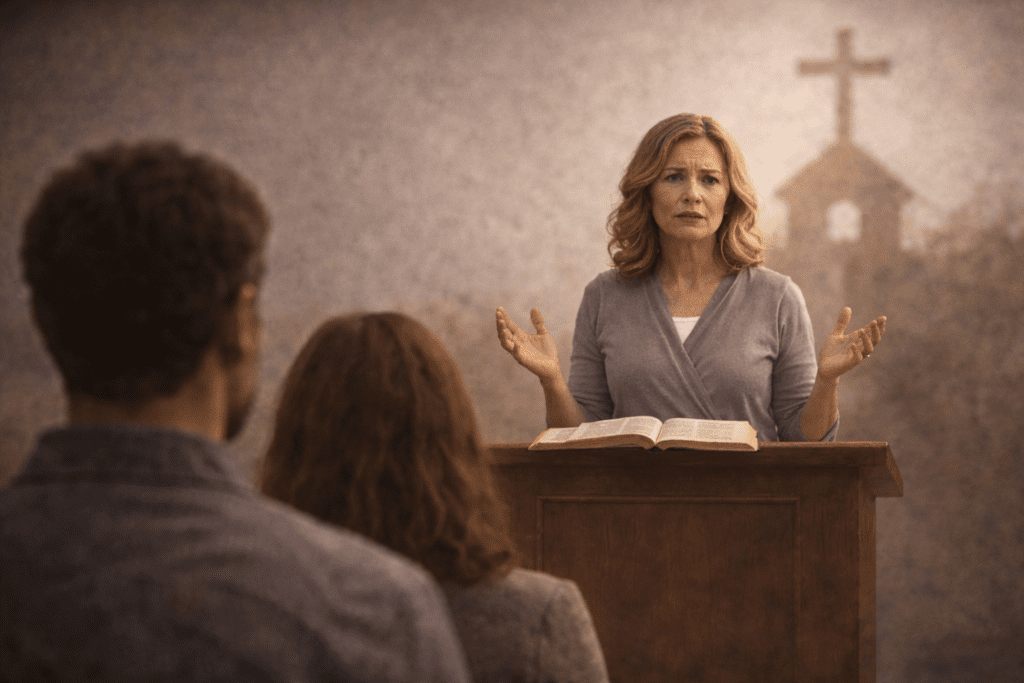
Short Answer: The Bible celebrates women as essential co-laborers in ministry, but it reserves the pastor/elder/overseer role for qualified men while calling churches to equip women to serve powerfully in many other leadership and teaching roles.
Long Answer: The Bible celebrates women as essential co-laborers in ministry, but it reserves the pastor/elder/overseer role for qualified men while calling churches to equip women to serve powerfully in many other leadership and teaching roles.
This is not a question about whether women are gifted, capable, or valuable. Scripture is clear: women are made in God’s image (Genesis 1:27), receive spiritual gifts (1 Corinthians 12:4–7), and played meaningful roles in the early church (Romans 16; Philippians 4:2–3). The question is narrower: what does the New Testament teach about the governing shepherd-role of elders/pastors in the local church?
What the Bible says about women in ministry
Women served faithfully and significantly in the mission of God:
- Women prayed and spoke in gathered worship settings in appropriate ways (1 Corinthians 11:5).
- Women helped strengthen and disciple believers (Titus 2:3–5).
- Women partnered in gospel work and were honored as co-laborers (Romans 16:1–3; Philippians 4:2–3).
- Women were part of Spirit-empowered ministry as the gospel advanced (Acts 2:17–18).
So the Bible does not minimize women. A healthy church should be eager to see women flourishing in service, discipleship, prayer, evangelism, counseling, ministry leadership, and teaching other women and children.
Can women be pastors or elders?
In the New Testament, the terms pastor (shepherd), elder, and overseer are closely connected to the same office of spiritual oversight and shepherding (Acts 20:17, 28; 1 Peter 5:1–3). When Scripture gives direct instruction about this office, it consistently presents it as male.
1) The gathered-church teaching and authority passage (1 Timothy 2)
Paul writes that he does not permit a woman “to teach or to exercise authority over a man” in the gathered church setting (1 Timothy 2:12). He roots his reasoning not in local culture but in creation order (2:13–14). In a Scripture-first reading, this points to a pattern: in the assembled church, the authoritative teaching/oversight role tied to governing leadership is entrusted to qualified men.
2) Elder qualifications (1 Timothy 3; Titus 1)
When Paul lists elder/overseer qualifications, he describes the overseer as “the husband of one wife” and frames the role in male terms (1 Timothy 3:1–7; Titus 1:5–9). The focus is strongly on character, maturity, and faithfulness—but the repeated framing fits the New Testament pattern of male eldership.
None of this suggests women are less spiritual or less gifted. It means God has designed complementary roles in the church, where men and women serve side by side, while the elder office is reserved for qualified men.
What this means for a healthy church
Churches should avoid two errors:
- Minimizing women’s gifts or limiting women beyond what Scripture teaches.
- Redefining the elder/pastor office in a way that conflicts with the New Testament pattern.
A church can hold a clear biblical conviction about elders and still be a place where women lead ministries, disciple deeply, teach faithfully in appropriate contexts, and shape the life and mission of the church in powerful ways.
What to do next
- Study the key passages carefully and in context (1 Timothy 2–3; Titus 1; 1 Corinthians 11; Acts 20; 1 Peter 5).
- Ask your church how it defines pastor/elder/overseer and how it equips both men and women for ministry.
- If you’re a woman sensing a call to ministry, pursue training and wise counsel, and look for robust ways to serve that honor Scripture and bless the church.
- If your church is divided on this topic, commit to humility and unity while staying faithful to God’s Word (Ephesians 4:1–3).
Key Scriptures: Gen 1:27; Acts 2:17–18; 1 Cor 11:5; 1 Tim 2:11–15; 1 Tim 3:1–7; Titus 1:5–9; Acts 20:17, 28; 1 Pet 5:1–3; Eph 4:1–3