
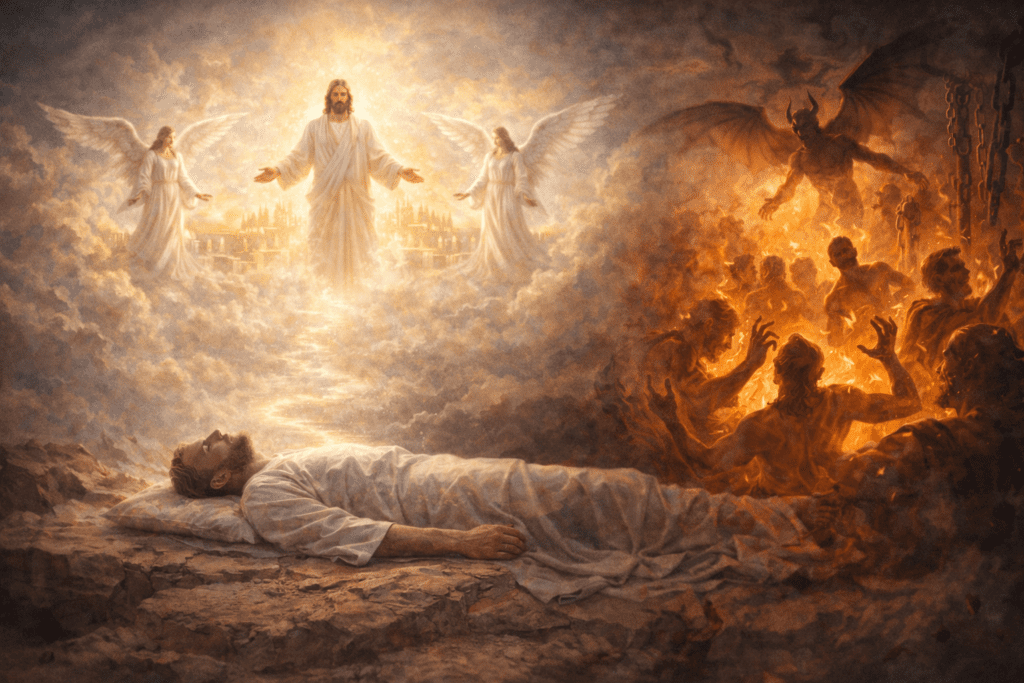
Short Answer: The Bible teaches that after death we face God, and our destiny depends on whether we belong to Christ; believers are with the Lord and await resurrection, while those who reject God face judgment, so the afterlife should move us to faith, repentance, and hope.
Long Answer: The Bible teaches that after death we face God, and our destiny depends on whether we belong to Christ; believers are with the Lord and await resurrection, while those who reject God face judgment, so the afterlife should move us to faith, repentance, and hope.
People ask this because death feels final and unknown. Scripture doesn’t answer every curiosity, but it does give enough truth to anchor your soul: God is real, Jesus rose from the dead, and your life is headed somewhere.
Death is not the end
The Bible describes death as the separation of body and spirit (James 2:26). It is an enemy brought into the world through sin (Romans 5:12), but it is an enemy Jesus has defeated through his resurrection (1 Corinthians 15:20–22).
What happens immediately after death?
Scripture points to a conscious reality after death. Paul says it is “better” to depart and be with Christ (Philippians 1:23), and he describes death for believers as being “away from the body” and “at home with the Lord” (2 Corinthians 5:8). Jesus’ story of the rich man and Lazarus also portrays awareness after death (Luke 16:19–31). While that passage is a parable, it strongly reinforces the idea that death does not erase personal existence.
Christians sometimes debate details of the “intermediate state” (the condition between death and the final resurrection). What is clear is this: believers are safe in God’s care and face the future with hope, not fear.
The final hope is resurrection, not disembodied existence
The Bible’s ultimate vision is not souls floating forever in the clouds. The core Christian hope is resurrection—God raising the dead and renewing creation (1 Corinthians 15; Revelation 21:1–5). When Jesus returns, the dead will be raised, and each person will stand before God (John 5:28–29).
This is why Christianity is not mainly about escaping earth but about God restoring all things under King Jesus.
Heaven and hell: the Bible’s sober clarity
Jesus spoke often about judgment. Scripture teaches a real separation:
- Eternal life with God for those who trust Christ (John 3:16; Romans 6:23).
- Judgment and separation from God for those who reject him (Matthew 25:46; 2 Thessalonians 1:8–9).
We should speak with humility and grief here, not with smugness. But we should not soften what Jesus himself warned about. God is just, and God is merciful.
How should this change how we live?
The Bible doesn’t give afterlife teaching for trivia—it gives it for urgency, comfort, and wisdom.
For believers, the afterlife fuels courage: death cannot steal Christ from you, and your future is resurrection life (1 Corinthians 15:54–58).
For those who are unsure, the afterlife calls for honest response: today is the day to turn to Jesus and trust him (2 Corinthians 6:2).
What to do next
- If you’re not sure where you stand with God, talk to him today. Confess your sin, trust Jesus, and commit to follow him (Acts 2:38; Romans 10:9–10).
- If you’re grieving, lean into Christian hope: in Christ, death is not the last word (1 Thessalonians 4:13–14).
- Live with eternity in view: forgive quickly, love deeply, and invest your life in what lasts (Colossians 3:1–4).
Key Scriptures: Phil 1:23; 2 Cor 5:8; Luke 16:19–31; John 5:28–29; 1 Cor 15:20–22, 54–58; Rom 6:23; Matt 25:46; Rev 21:1–5; 1 Thess 4:13–14