
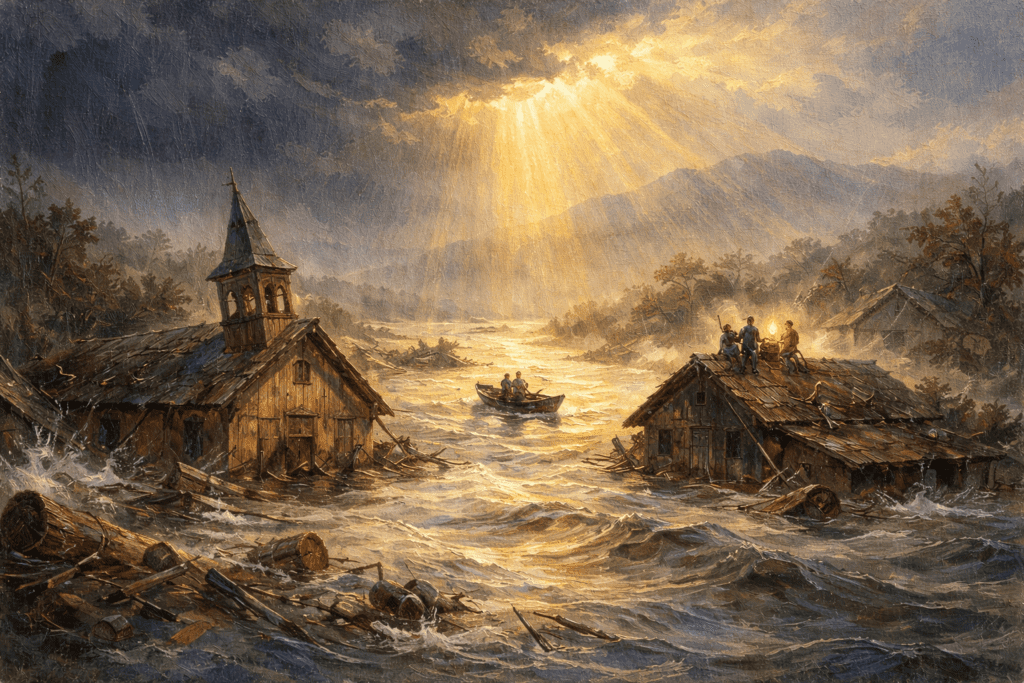
Short Answer: God has used disasters as judgment at times in the Bible, but Jesus warns us not to assume every storm today is God punishing specific people; our response should be humility, repentance, and mercy.
Long Answer: When a tornado levels homes or a flood sweeps through a town, it’s normal to ask what it means. Pain makes us search for reasons. Are storms or disasters God’s judgment? The Bible gives a careful answer: God is sovereign and can judge, yet we are not given permission to confidently label every tragedy as God’s direct punishment on the victims.
That balance matters. If we only say, “God is judging,” we can become harsh and careless with hurting people. If we only say, “God has nothing to do with it,” we lose the comfort that God is present, purposeful, and able to redeem suffering. Scripture calls us to a wiser posture: reverent humility, honest grief, and active love.
God can use calamity for judgment, and Scripture sometimes says so plainly
In the Old Testament, there are events where God clearly explains that he is bringing judgment and why. The flood in Noah’s day (Genesis 6–7), the plagues on Egypt (Exodus 7–12), and prophetic warnings that link national rebellion with national consequences show that God can judge through history and even through creation.
God is holy and just. He doesn’t shrug at evil. The Bible also points forward to a final day when God will judge the world with perfect righteousness through Jesus (Acts 17:31; Revelation 20:11–15). That future judgment reminds us that moral accountability is real, even when justice seems delayed.
But we should notice something important: in those biblical moments, God revealed the meaning of the event through his word—through prophets, through clear covenant warnings, or through direct revelation. That is different from us looking at modern disasters and declaring, “God told me exactly why this happened.”
Jesus warns against assuming tragedy proves specific guilt
Jesus directly addresses this kind of question. In Luke 13:1–5, people bring him a news report about a horrifying act of violence. Jesus adds another example: a tower that collapsed and killed eighteen people. His conclusion is surprising: those who died were not “worse sinners” than everyone else.
Jesus refuses the simple story line that suffering is always a direct measure of personal wickedness. Then he turns the moment into a warning for all: “Unless you repent, you will all likewise perish.” His point is not, “Blame the victims.” His point is, “Let the fragility of life wake you up. You also need to be right with God.”
So when disasters happen, the most biblical move is not to point outward with certainty, but to look upward with reverence and inward with repentance.
A fallen world means many disasters are part of creation’s brokenness
The Bible describes the world as good in its beginning (Genesis 1), but damaged by sin (Genesis 3). Romans 8:18–23 says creation itself “groans,” longing for the day of renewal. This helps us understand why the world can be both ordered and unstable, beautiful and dangerous.
God “makes his sun rise on the evil and on the good” (Matthew 5:45). That verse isn’t about disasters specifically, but it shows a pattern: many events in this world do not sort neatly into “good people get good outcomes” and “bad people get bad outcomes.” Weather falls on all kinds of people. The same is true of illness, accidents, and many kinds of suffering.
That doesn’t mean God is absent. It means we should be cautious about pretending we can read God’s secret purposes off a weather map.
Sometimes God disciplines his people, but discipline is not the same as condemnation
The Bible does teach that God lovingly disciplines his children (Hebrews 12:5–11). Discipline is aimed at restoration, maturity, and holiness, not humiliation. It’s the difference between a father training a child and a judge sentencing a criminal.
It’s also true that sin has consequences. Choices can bring painful results (Galatians 6:7–8). Communities can be harmed by injustice and greed. But even when consequences exist, we still can’t automatically say, “This specific tornado is God’s punishment for that specific sin.” Scripture warns against that kind of certainty.
If God is convicting you personally through hardship, respond tenderly: repent, seek counsel, and trust his love. But don’t weaponize someone else’s suffering to sound spiritually confident.
One common misunderstanding to avoid
A damaging idea is: People hit by disasters must be under God’s anger more than others. Jesus corrects that directly (Luke 13:1–5). Another place Scripture pushes back is John 9:1–3, where the disciples assume a man’s suffering must be linked to someone’s specific sin. Jesus rejects their blame game and points them to God’s work.
The book of Job is also a warning label on simplistic explanations. Job’s friends sound confident, but God rebukes them for speaking wrongly about him (Job 42:7). Sometimes the most “certain” voices are the least faithful.
Humility is not a lack of faith. Humility is obedience.
What should we say with confidence when disasters happen?
Even when we can’t explain the “why,” Scripture gives us firm ground to stand on.
God is present. “The LORD is near to the brokenhearted” (Psalm 34:18).
God is a refuge. “God is our refuge and strength” (Psalm 46:1–3).
God is patient. He desires repentance, not destruction (2 Peter 3:9).
God will make things right. Jesus will judge evil and heal what’s broken (Acts 17:31; Revelation 21:4).
God proved his love in Christ. The cross shows God entering our suffering, and the resurrection promises death will not win (1 Corinthians 15:20–26).
That means we don’t have to choose between truth and tenderness. We can say, “God is holy,” and also say, “God is compassionate.” We can call people to repentance without claiming insider knowledge about a particular event.
How should Christians respond in real life?
When storms or disasters strike, the Bible’s strongest call is not to speculate but to serve.
- Lament honestly. Grief is not faithlessness. The Psalms teach us to cry out to God with real words (Psalm 46; Psalm 13).
- Repent quickly. Tragedy is a sober reminder that life is fragile and eternity is real (Luke 13:5).
- Help tangibly. Love of neighbor looks like food, shelter, cleanup, money, and presence (James 2:15–17).
- Pray and persist. Ask God for mercy, for protection, for wisdom, and for endurance.
- Hold up the gospel. In Jesus, God meets us in suffering and offers forgiveness, new life, and unshakable hope.
If you’re asking these questions because you’re scared or grieving, remember this: God is not asking you to decode every disaster. He is inviting you to trust him, turn from sin, and walk with him—together with his people—until the day he makes all things new.
What to do next
- If you’re impacted by a disaster, reach out to a local church or trusted believers for prayer, practical help, and support.
- If you’re tempted to assign blame, pause and follow Jesus’ lead: humble yourself, repent, and refuse to accuse sufferers (Luke 13:1–5).
- Choose one concrete act of mercy today: donate, volunteer, check on neighbors, or help a family rebuild.
- If you’re uncertain about your relationship with God, turn to Jesus in faith—repent, confess him, and pursue baptism by immersion as the Bible’s normal response of faith, in connection with a healthy local church (Acts 2:38; Romans 6:3–4).
- Keep anchoring your heart in God’s promises: he is near, he is just, and he will restore what sin has shattered.
Key Scriptures: Luke 13:1–5; John 9:1–3; Romans 8:18–23; Matthew 5:45; Hebrews 12:5–11; Job 42:7; Psalm 34:18; Psalm 46:1–3; Acts 17:31; 2 Peter 3:9; 1 Corinthians 15:20–26; Revelation 21:4