
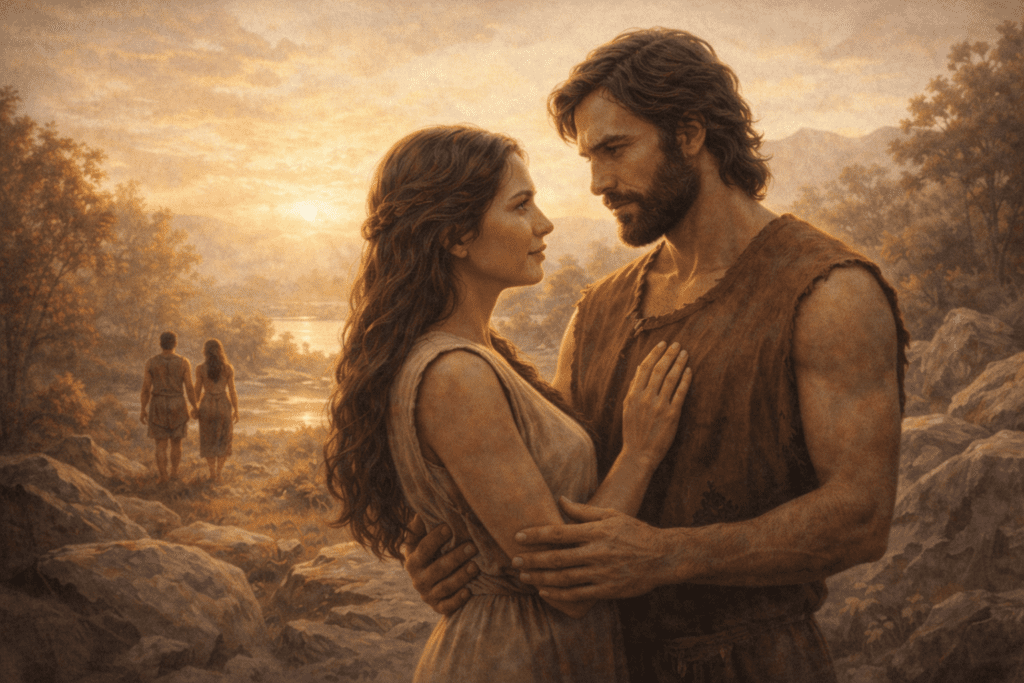
The Bible doesn’t name Cain’s wife, but Genesis points to Cain marrying a woman from Adam and Eve’s expanding family—most likely a sister or niece.
Genesis often tells the story with just a few key names, not every detail we might want. That’s why it can feel surprising when Cain’s wife suddenly appears in the narrative. Where did Cain’s wife come from? Who did Cain marry according to the Bible? Scripture doesn’t give her name, but it does give enough information to make a reasonable conclusion: Cain married a close relative from Adam and Eve’s family line.
In Genesis 4, we read about Cain and Abel, their offerings, Cain’s jealousy, and the tragic murder of Abel (Genesis 4:1–8). After God confronts Cain and pronounces judgment, Cain leaves the area and settles “in the land of Nod, east of Eden” (Genesis 4:16). Then the text says, “Cain knew his wife, and she conceived and bore Enoch” (Genesis 4:17). That raises the natural question: where did she come from if Adam and Eve are the first couple presented in the storyline?
The clearest biblical clue comes a chapter later: “The days of Adam… and he had other sons and daughters” (Genesis 5:4). Genesis doesn’t list their names there, because the author is tracing the main lines of the story, not trying to provide a full family registry. But that single statement makes it plain that Adam and Eve’s household eventually included many children beyond the few who are named. Cain’s wife would have come from that larger family.
The Bible’s direct answer: Genesis doesn’t name her, but it does locate her
Let’s be honest about what we can and cannot say.
What the Bible does not tell us:
- Her name
- Exactly when she was born
- Whether she was Cain’s sister, niece, or another close relative
- How many siblings Cain had at the time of his exile
What the Bible does tell us:
- Adam and Eve had more children than the ones highlighted in the story (Genesis 5:4)
- Humanity began with Adam and Eve in the Genesis storyline (Genesis 3:20; Genesis 5:1–2)
- Cain had a wife and children (Genesis 4:17)
- Cain feared being attacked by others after his punishment (Genesis 4:14–15)
So, while Scripture leaves some blanks, it does not leave us with nothing. The most straightforward reading is that Cain married someone from the growing human family descended from Adam and Eve.
Why Cain’s fear suggests there were already more people around
When Cain is judged, he says, “Whoever finds me will kill me” (Genesis 4:14). That line doesn’t make much sense if there are only three people alive: Adam, Eve, and Cain. It suggests that, by the time Cain is sent away, there are others who could “find” him—extended family members, likely including siblings and possibly nieces and nephews as the first generations matured.
Genesis doesn’t stop to count them because that’s not the main point of the chapter. The point is the spread of sin: jealousy becomes violence, violence fractures relationships, and Cain moves farther “east of Eden,” symbolizing distance from God’s presence (Genesis 4:16).
In other words, Cain’s fear fits naturally with what Genesis later confirms: Adam’s family grew beyond the few names we’re given.
Who did Cain marry: sister or niece?
If Adam and Eve had “sons and daughters” (Genesis 5:4), then Cain’s wife would have been a close relative. Two common options fit the timeline without forcing the text:
- A sister: One of Adam and Eve’s unnamed daughters.
- A niece: A daughter of one of Cain’s younger siblings (if enough time had passed for another generation to reach marriage age).
Genesis doesn’t settle which option is correct, and we should be careful not to speak more confidently than Scripture does. But either way, the answer remains the same: Cain married someone from Adam and Eve’s family.
Is this the same as later incest laws in the Old Testament?
Many readers immediately think, “But the Bible forbids incest!” That’s true—later in Israel’s history, God clearly prohibits sexual unions between close relatives (Leviticus 18:6–18). So how do we think about Genesis 4?
A few important guardrails help:
- Different time in the storyline: Genesis 4 describes the earliest generations of humanity. Leviticus addresses Israel as a formed covenant nation much later.
- Genesis is descriptive here, not celebratory: The text reports what happened; it doesn’t present Cain’s line as a moral model. In fact, Genesis 4 highlights sin’s spread and its painful consequences.
- God’s design remains good from the beginning: Marriage is rooted in God’s creation purpose—one man and one woman united as “one flesh” (Genesis 2:24; Matthew 19:4–6). The brokenness we see in early Genesis reminds us why God later gave clearer boundaries for family life and holiness.
So, we don’t have to pretend this feels comfortable. We can simply say: if humanity begins with one couple, early intermarriage among close relatives is part of that beginning stage. Later, God gives explicit commands that protect families and set Israel apart.
A common misunderstanding: “Cain married someone from a separate group of humans”
Some people propose that Cain must have found a wife from another population outside Adam and Eve’s family. They may suggest there were other humans created separately or living elsewhere.
Christians sometimes raise that idea because they’re trying to solve the “who else was there?” question. But the Bible’s storyline consistently traces humanity back to Adam:
- Eve is called “the mother of all living” (Genesis 3:20).
- The genealogy framework presents Adam as the starting point for the human family (Genesis 5:1–2).
- The New Testament treats humanity as one family descended from one man (Acts 17:26).
- The gospel logic of Jesus as the “last Adam” assumes Adam’s representative role for the human race (Romans 5:12–19; 1 Corinthians 15:21–22, 45).
That doesn’t answer every modern curiosity about population sizes or timelines. But biblically, the most coherent reading is that Cain’s wife came from Adam and Eve’s descendants, not from an unrelated group.
Why Genesis includes this detail at all
It can feel like Genesis 4 drops Cain’s wife into the story without warning. But the narrative isn’t trying to make her the focus. Genesis 4 is showing two paths developing in the early world:
- A path of resentment and self-protection (Cain)
- A path of calling on the name of the Lord (seen later in Genesis 4:26)
Cain’s marriage and children matter to the story because they show that Cain didn’t simply disappear—he built a life and a legacy. He founded a city (Genesis 4:17) and became the head of a line that includes cultural development (tools, music) alongside escalating violence and pride (Genesis 4:19–24). Genesis is honest: humans can build impressive things while their hearts remain far from God.
That honesty prepares us for the bigger message of the Bible: we need more than better culture or stronger families. We need a changed heart.
How this question points us to the gospel
Questions about genealogies can become a rabbit trail, but Genesis wants to do more than satisfy curiosity. It wants to confront us with sin’s power and our need for God’s mercy.
Cain is warned, “Sin is crouching at the door… but you must rule over it” (Genesis 4:7). Cain refuses, and the result is death, exile, and alienation. That pattern—sin leading to death—echoes throughout Scripture (Romans 6:23). But the Bible does not leave us with Cain as the final word.
God’s plan moves forward through the line of promise, ultimately fulfilled in Jesus—the true and better representative for humanity. Where Adam failed and where Cain’s sin spread, Jesus obeys, gives himself for sinners, rises again, and offers forgiveness and new life (Romans 5:17–19; 1 Corinthians 15:21–22). That’s the hope Genesis is slowly setting up: God is not done with a world broken by sin.
So, yes, we can answer the historical question: Cain married someone from Adam and Eve’s family. But the deeper invitation is this: don’t live “east of Eden” in your own strength. Come back to God through Jesus.
What to do next
- Read Genesis 4–5 slowly and note what Scripture says directly versus what it leaves unstated.
- If this question stirs doubts, talk with a pastor/elder or trusted mature Christian who can walk through the text with you.
- Ask God for wisdom and humility to trust him when a passage doesn’t answer every detail we want (James 1:5).
- If you’re not yet following Jesus, respond with faith that includes repentance and allegiance: confess Jesus as Lord and be baptized for the forgiveness of sins, and connect with a healthy local church for ongoing discipleship and support (Acts 2:38–41).
- If you are following Jesus, let Cain’s story warn you early—bring anger into the light quickly through prayer, confession, and accountability in Christian community (Ephesians 4:26–27; 1 John 1:7–9).
Genesis 4:1–17; Genesis 5:1–4; Genesis 3:20; Genesis 2:24; Genesis 4:7; Leviticus 18:6–18; Acts 17:26; Romans 5:12–19; 1 Corinthians 15:21–22, 45; James 1:5; Acts 2:38–41; 1 John 1:7–9
