
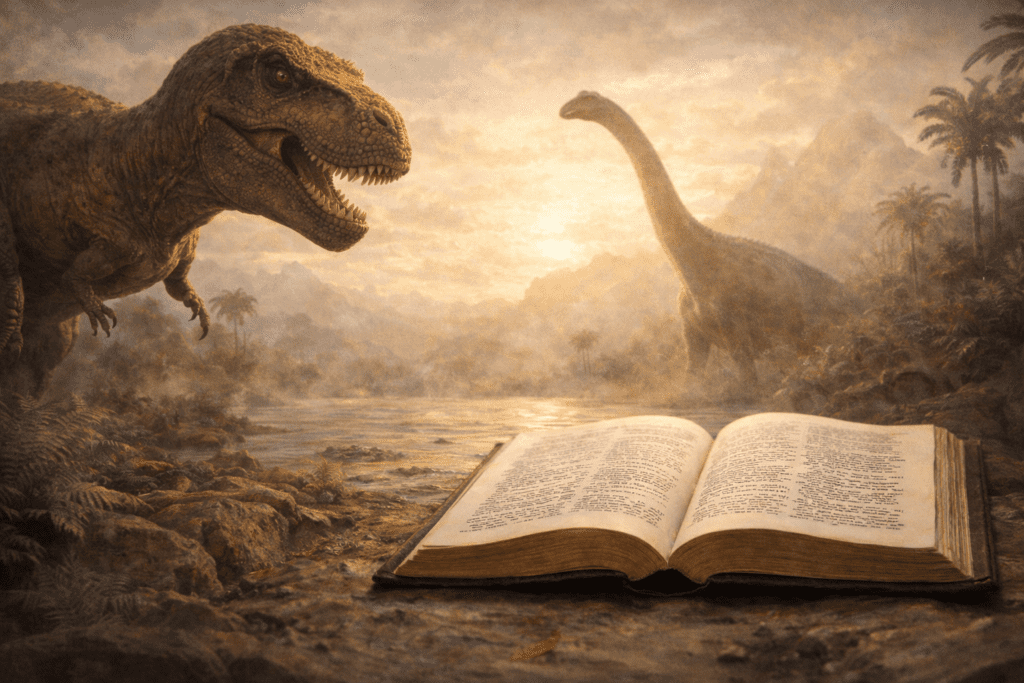
Short Answer: The Bible doesn’t use the modern word “dinosaur,” but it teaches God created all creatures, so Christians can affirm dinosaurs existed while holding different views on when they lived and how they fit into the Genesis timeline.
Long Answer: The Bible doesn’t use the modern word “dinosaur,” but it teaches God created all creatures, so Christians can affirm dinosaurs existed while holding different views on when they lived and how they fit into the Genesis timeline.
“Dinosaur” is a modern term, so we shouldn’t expect to find it in an ancient text. The more important question is: does Scripture allow for large, extinct creatures, and how should Christians think about them while honoring both God’s Word and God’s world?
Does the Bible talk about dinosaurs by name?
No. The Bible never says “dinosaur.” But it does speak broadly about God creating animals and filling the earth with living creatures (Genesis 1:20–25). If dinosaurs were part of earth’s history, they fall under “all things” God created.
Some people also point to creatures described in Job—“behemoth” (Job 40:15–24) and “leviathan” (Job 41). These descriptions are vivid and dramatic, but Scripture does not explicitly identify them as dinosaurs. Many Christians interpret them as poetic descriptions of powerful creatures (possibly known animals, possibly symbolic imagery). So we should avoid dogmatic claims like “behemoth was definitely a sauropod.” The text doesn’t say that.
How can Christians think about dinosaurs and Genesis?
Faithful Christians generally agree on the essentials:
- God created the world intentionally (Genesis 1:1).
- Creation displays God’s power and wisdom (Psalm 19:1; Romans 1:20).
- Scripture is trustworthy.
Where Christians differ is on the timing and mechanics of creation.
Common Christian views (without fighting about it)
- Some hold that dinosaurs were created during the creation week and lived long ago, possibly even overlapping with early humans depending on how they read Genesis.
- Others hold that dinosaurs lived millions of years ago and became extinct long before humans, interpreting Genesis days in a different way.
These disagreements should be handled with humility. Dinosaurs are not the center of the gospel. What matters most is that God is Creator and we are accountable to him.
Why this matters spiritually
Dinosaurs can either become a stumbling block or a doorway to wonder. Scripture invites us to worship the God who made a world so large, complex, and awe-inspiring that it still surprises us. Whether you’re looking at fossils, museum exhibits, or scientific discussions, the Christian instinct should be: “God, you are great.”
At the same time, Christians should be careful not to build their faith on speculative claims. Our faith rests on Christ—his death and resurrection—not on a particular dinosaur timeline.
What to do next
- Read Genesis 1–2 and focus on the main message: God created with purpose and authority.
- Hold your view with conviction and humility, remembering the gospel is central.
- If dinosaurs raise doubts for you, talk with a mature believer and work through the question slowly—don’t let internet arguments shape your faith.
- Let creation move you to worship and trust (Psalm 19:1).
Key Scriptures: Gen 1:20–25; Gen 1:1; Psalm 19:1; Rom 1:20; Job 40:15–24; Job 41:1–34