
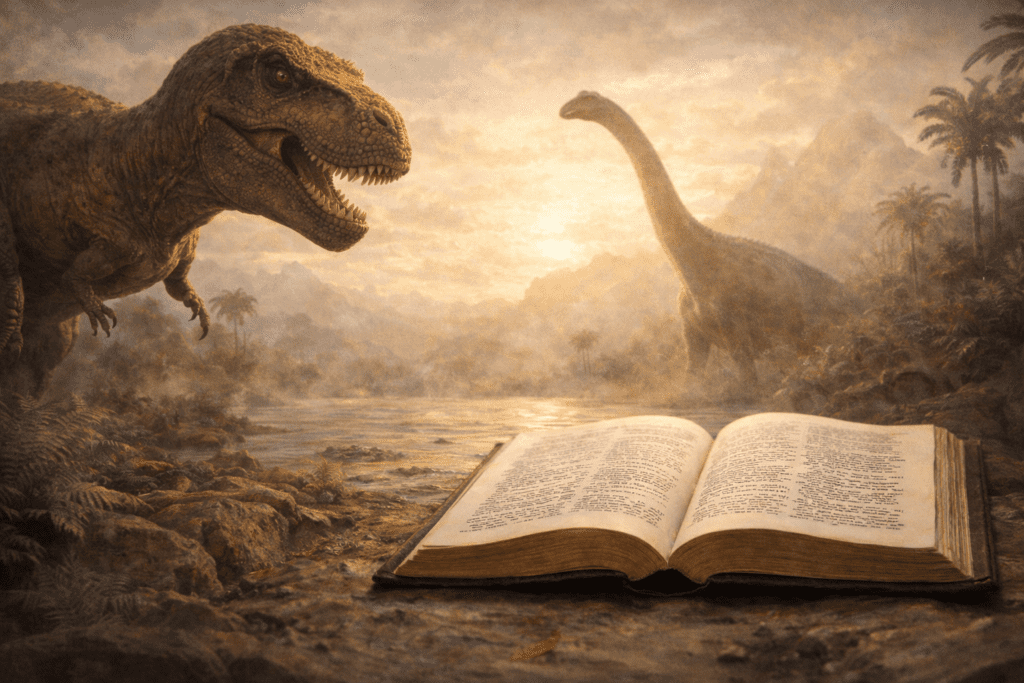
Does the Bible mention dinosaurs? How should Christians think about dinosaurs and Scripture?
,

Does the Bible mention dinosaurs? How should Christians think about dinosaurs and Scripture?

This question sits near an essential: God exists (and is to be earnestly sought).

The Bible doesn’t use the modern word dinosaur, but it teaches God created every kind of creature and rules over all of history—so Christians can accept dinosaurs as real while reading Scripture faithfully.

Dinosaurs capture our imagination because they feel both familiar and mysterious—real animals, yet far removed from our everyday world. Does the Bible mention dinosaurs? How should Christians think about dinosaurs and Scripture? The Bible doesn’t give a modern list of species or use modern scientific labels, but it does give a clear foundation: God made the world on purpose, God made living creatures, and God is worthy of trust even when we don’t have every detail.

The Bible’s main goal is not a science catalog

When you open Scripture, you’re not reading an encyclopedia of every animal that has ever lived. The Bible was written to reveal God, expose sin, announce redemption, and form God’s people into faithful disciples. That means it often speaks in broad categories—“living creatures,” “beasts of the earth,” “great sea creatures”—rather than in the technical terms we use today (Genesis 1:20–25).

So, the absence of the word dinosaur is not a problem for biblical faith. The term itself is modern. The deeper question is whether Scripture leaves room for creatures that lived long ago and are now extinct. And the answer is yes: if God created “the heavens and the earth” and the creatures that fill them, then extinct animals fall under his creative authority too (Genesis 1:1; Psalm 104:24).

What Genesis teaches that matters for this question

Genesis 1 is clear about several anchor truths that shape how Christians think about the natural world:

  • God is the Creator. Everything that exists depends on him (Genesis 1:1).
  • Animals are part of God’s good world. Land animals and sea creatures are included in his “very good” creation (Genesis 1:24–25, 31).
  • Humans are not accidents. People are made in God’s image with dignity and responsibility (Genesis 1:26–28).
  • Creation is meant to lead us to worship. The world points beyond itself to the wisdom and power of God (Psalm 19:1; Romans 1:20).

Those truths still stand even when we ask detailed questions about fossils, extinctions, or timelines. Christians can study the created world with confidence that God is not competing with truth—God is the source of truth.

Are “behemoth” and “leviathan” dinosaurs?

Job 40–41 is the passage many people think of when dinosaurs come up. In these chapters, God speaks to Job about powerful creatures: behemoth (Job 40:15–24) and leviathan (Job 41:1–34). The descriptions are vivid and awe-inspiring, and the point is unmistakable: Job is small, God is great, and God governs what humans cannot control (Job 40:1–2; 41:10–11).

Faithful Christians have offered different understandings of these creatures:

  • Some think behemoth and leviathan could describe large, fearsome animals that sound dinosaur-like.
  • Others understand them as poetic descriptions of known animals (often compared to the hippopotamus and crocodile) used to humble Job.
  • Others emphasize that these creatures function as “untamable” symbols in the story, highlighting God’s dominion over what feels chaotic or terrifying.

Whichever view you take, Job doesn’t require you to identify a species to receive its message. The message is worship and humility: God is wise, powerful, and trustworthy even when we feel overwhelmed.

How can Christians hold Scripture and scientific discovery together?

For many believers, the real tension isn’t “Are dinosaurs real?” but “How do I connect fossils, deep time, and Genesis without losing confidence in the Bible?”

A steady Christian approach includes at least three commitments.

Hold firmly to what Scripture clearly teaches.
The Bible is not vague about God’s identity, humanity’s value, the reality of sin, and God’s plan to save. It also isn’t vague about Jesus—his death for our sins, his resurrection, and his lordship (1 Corinthians 15:3–4; Colossians 1:16–17). Our faith doesn’t rise or fall on our ability to reconstruct the ancient world in modern categories. It rests on the God who acted in history, especially in Christ.

Be humble about what Scripture does not specify.
Genesis tells us God created, but Christians interpret details like the “days” of Genesis in different ways. Some hold to a young-earth reading; others believe an old-earth reading fits the text while still affirming God as Creator. You can be devoted to Scripture and land in different places on timing questions. Humility means admitting that some issues require careful study, and that not every faithful person will agree.

Refuse false choices.
Sometimes people present only two options: “Either you accept dinosaurs and reject the Bible,” or “You trust the Bible and deny what’s obvious in the natural world.” Those are not the only options. Christians can fully trust Scripture as God’s Word and also acknowledge that God’s world includes extinct animals and a complex history.

What dinosaurs can teach us spiritually

Even if dinosaurs aren’t named in Scripture, they can still serve a spiritual purpose by deepening awe.

  • They remind us that God’s creation is bigger and more varied than our daily experience.
  • They encourage humility: we are not the center of the universe.
  • They can stir worship: “How many are your works, LORD! In wisdom you made them all” (Psalm 104:24).

In other words, dinosaurs don’t have to be a battleground. For many people, they become a doorway into wonder—an invitation to praise the Maker.

A common misunderstanding to avoid

One common misunderstanding is assuming: “If the Bible doesn’t mention something by name, the Bible must be incomplete or unreliable.”

But the Bible’s purpose is not to mention everything; it is to reveal what we need to know to trust God and follow him. John even notes that not everything Jesus did was written down (John 21:25). Scripture is sufficient for salvation and godly living (2 Timothy 3:16–17), even though it doesn’t answer every curiosity.

Another misunderstanding goes the opposite direction: “If science raises questions, Scripture must be wrong.” Christians don’t need to fear questions, because truth ultimately belongs to God. Honest questions can be part of honest faith—especially when they lead us to study, prayer, and deeper trust.

Keep the gospel at the center

If discussions about fossils, timelines, or animals start to feel like your whole faith is on the line, it’s time to re-center. The heart of Christianity is Jesus Christ: crucified for our sins, raised from the dead, reigning as Lord, and returning as King (1 Corinthians 15:3–4). The same God who created the world is the God who entered the world to save sinners.

That means you can say, with confidence: “I don’t have to understand every detail about the ancient past to follow Jesus today.”

What to do next

  • Read Genesis 1–3 and write down what it clearly says about God, humanity, and sin.
  • Read Job 38–41 and notice how God uses creation to build trust and humility.
  • If this topic unsettles you, talk with a pastor/elder or a mature Christian who can walk with you patiently.
  • Pray for faith that welcomes honest questions and rests in God’s character.
  • If you’re exploring Christianity, visit a healthy local church, ask leaders your questions, and learn what it means to repent, confess Jesus as Lord, and be baptized as you begin a life of discipleship (Acts 2:38).

Genesis 1:1; Genesis 1:20–25; Genesis 1:26–28; Job 40:15–24; Job 41:1–34; Psalm 19:1; Psalm 104:24; Romans 1:20; Colossians 1:16–17; 1 Corinthians 15:3–4; 2 Timothy 3:16–17; John 21:25

Have a question of your own?

Ask it — every answer is grounded in Scripture and carefully reviewed.

Secret Link