
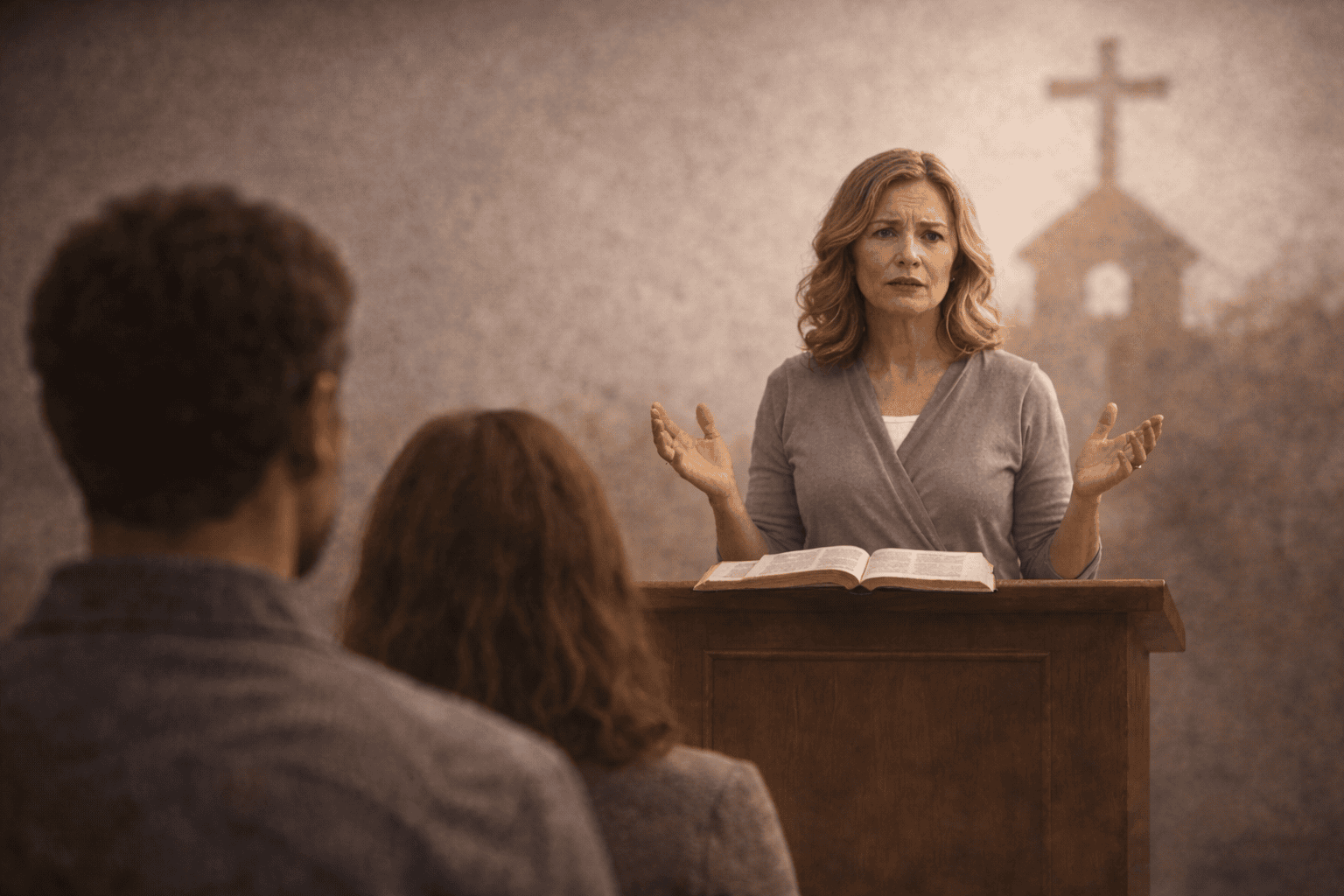
The Bible celebrates women as vital co-laborers in the mission of Jesus, while also reserving the office of elder/pastor—the church’s lead teaching and oversight role—for qualified men.
The Bible holds two truths together without apology: women are equally made in God’s image and richly gifted by the Holy Spirit, and God also gives the church a clear pattern for who serves in the elder/pastor office. Somewhere in the middle of that tension, many sincere people ask, “Can women serve as pastors or elders? What does the Bible teach about women in church leadership?” Scripture answers by affirming women’s indispensable ministry and by setting boundaries for the governing, authoritative teaching office in the gathered church.
This isn’t a question about talent, intelligence, or worth. It’s a question about faithfulness to God’s design for the church. When we listen carefully to the New Testament, we see women serving powerfully in ministry—and we also see that elders/overseers (often called pastors) are consistently described as qualified men who shepherd, teach, and guard the church.
Start with what the Bible clearly honors about women
From the opening pages of Scripture, God dignifies both men and women as image-bearers (Genesis 1:27). In Christ, women and men share equal standing as heirs of grace (Galatians 3:28; 1 Peter 3:7). That means the church should never treat women as “second-class” disciples or assume their contributions are optional.
The New Testament repeatedly shows women as courageous participants in God’s work:
- Women were the first witnesses of Jesus’ resurrection and were entrusted to carry that news (Matthew 28:1–10; John 20:16–18).
- Women prayed and prophesied in the early church (Acts 2:17–18; 1 Corinthians 11:5).
- Priscilla, alongside her husband Aquila, helped instruct Apollos more accurately (Acts 18:26).
- Phoebe is commended as a servant and benefactor to many (Romans 16:1–2).
- Older women are explicitly called to teach and disciple younger women in the faith (Titus 2:3–5).
So the Bible does not picture women as silent spectators. Women are active, Spirit-empowered builders of the church. Any church culture that minimizes women’s gifts, discourages their service, or ignores their wisdom is out of step with Scripture’s tone and practice.
What is an elder or pastor, biblically speaking?
In the New Testament, the terms elder, overseer, and shepherd/pastor are closely connected and often refer to the same office (Acts 20:17, 28; 1 Peter 5:1–3). Elders are charged with weighty responsibilities:
- Shepherding God’s people with care and humility (1 Peter 5:1–3)
- Teaching sound doctrine and refuting error (Titus 1:9)
- Watching over the spiritual health of the church (Acts 20:28–31; Hebrews 13:17)
This matters because the debate is not simply, “Can women lead?” The Bible plainly shows women leading in various ways. The more specific question is, “Can women hold the church office that carries governing oversight and the primary teaching authority in the gathered assembly?”
The key texts that set boundaries for the elder/pastor office
Two passages are especially important because they speak directly to the church’s order and leadership.
1 Timothy 2:11–14
Paul instructs that a woman is to learn quietly and that he does not permit a woman to teach or to exercise authority over a man in that setting (1 Timothy 2:11–12). He then grounds his instruction in creation and the fall narrative (1 Timothy 2:13–14). In other words, Paul does not frame this as a temporary policy based only on local preferences; he connects it to the created order and a theological rationale.
Christians disagree about all the details of how to apply this today, but the plain sense is that Paul is describing a limit connected to authoritative teaching and governance in the gathered church.
1 Timothy 3:1–7 and Titus 1:5–9
When Paul describes the qualifications for elders/overseers, he portrays the office-holder as “the husband of one wife,” a mature and faithful man who can teach sound doctrine and lead well (1 Timothy 3:1–7; Titus 1:5–9). These lists are not just personality profiles; they are job requirements for the office of overseer/elder.
Put simply: the New Testament consistently ties the elder/pastor office to qualified men. This is not because women are less gifted, but because God assigns the church’s final teaching-and-oversight responsibility to male elders.
How can women speak and minister if there are boundaries?
This is where many people feel stuck. If women prayed and prophesied (1 Corinthians 11:5) and if Priscilla helped instruct Apollos (Acts 18:26), doesn’t that mean women can be pastors?
Not necessarily. The New Testament gives evidence that women participated vocally in the life of the church, but it also shows that elder oversight and the governing teaching office were distinct. A helpful way to think about it is this:
- Women can and should use their gifts to strengthen the church in many forms of teaching, discipleship, encouragement, prayer, evangelism, mercy ministry, administration, and mission.
- The church’s elder/pastor office—the role responsible for authoritative doctrine-setting and spiritual oversight of the congregation—is reserved for qualified men.
This is why many Bible-honoring churches invite and empower women to teach in contexts that do not place them in the elder’s authoritative governing role over men (for example, teaching women, teaching children, training ministries, discipleship groups, writing, counseling, leading ministry teams, missions, and speaking in various settings under elder oversight). The goal is not to shrink women’s ministry; it is to place every gift in a pattern Scripture seems to outline.
A common misunderstanding: role differences mean women are “less than”
One of the most painful misunderstandings is the idea that if the elder/pastor role is male-only, then women are not equally valued. That conclusion does not follow biblically.
The Bible regularly shows difference in role without difference in worth. Jesus is fully divine and equal with the Father, yet he willingly submitted to the Father’s will in his mission (John 5:19; 1 Corinthians 15:28). Submission in role is not inferiority in value.
In the same way, Scripture’s church order is not a statement about women’s intelligence, spirituality, leadership capacity, or closeness to God. It is a statement about how God wants the church to be structured so that the church reflects Christ’s headship and the family-like nature of God’s household (Ephesians 5:23; 1 Timothy 3:15).
Why would God design it this way?
The Bible doesn’t answer every “why” to our satisfaction, but it does give several themes that help us trust God’s wisdom.
- The church is God’s household. Paul connects leadership and household faithfulness (1 Timothy 3:4–5), indicating that how leaders lead at home relates to how they shepherd the church.
- Elders carry a protective responsibility. They must be able to teach sound doctrine and guard the flock from wolves (Titus 1:9; Acts 20:28–31).
- God uses embodied symbols. Scripture often connects leadership patterns to creation and to Christ’s relationship to his church (Genesis 2:18–24; Ephesians 5:23–32).
Even when we don’t feel every “why” in our bones, we can still choose to honor God’s Word in faith—especially when the New Testament speaks directly and repeatedly about an office.
What about churches that appoint women as pastors?
Many sincere Christians who love Jesus and respect the Bible reach different conclusions. Some argue that Paul’s instructions addressed specific problems in Ephesus and Corinth and should not be applied as a timeless boundary. They also emphasize examples of women speaking, prophesying, and laboring in mission.
Others conclude that the clearest reading of 1 Timothy 2–3 and Titus 1 is that the elder/pastor office is male, and that Paul grounds this practice in creation and the nature of church authority, not merely local culture.
If you’re trying to follow Scripture, it’s wise to:
- acknowledge that believers disagree,
- avoid assuming the “other side” is trying to dishonor God,
- and still let the most direct teaching passages about church order shape your convictions and practice (1 Timothy 2:11–14; 1 Timothy 3:1–7; Titus 1:5–9).
A hopeful vision for women in church leadership
A church that follows the Bible’s pattern should be both ordered and overflowing with ministry. That means women are not only “allowed” to serve; they are needed.
Healthy churches will actively cultivate women to:
- disciple other women and children (Titus 2:3–5)
- lead ministries of mercy, prayer, hospitality, and outreach (Romans 12:6–8; 1 Peter 4:10–11)
- serve as deacons or in deacon-like roles where biblically appropriate (Romans 16:1–2)
- teach and train in many settings under the care of elders (Acts 18:26)
- partner in mission and evangelism as full co-laborers (Philippians 4:2–3)
The goal is not to fit women into a narrow corner. The goal is to let women’s gifts flourish in ways that build up the whole body—while still honoring Scripture’s guidance for the elder/pastor office.
What to do next
- Read 1 Timothy 2–3 and Titus 1 slowly, asking what they say about church order and the elder’s responsibilities.
- Talk with your church’s pastors/elders about how your congregation applies these passages and how women’s gifts can be strengthened and supported.
- If you’re a woman sensing a call to ministry, ask leaders where you can serve and grow through training, mentoring, and meaningful responsibility in the church.
- If this issue has caused hurt or confusion, seek a wise conversation with a trusted pastor/elder and a mature Christian woman who can walk with you through Scripture.
- If you’re exploring faith, start with Jesus: repent, confess him as Lord, and pursue baptism by immersion as the normal response of faith—then commit to a healthy local church for lifelong discipleship (Acts 2:38; Matthew 28:18–20).
Genesis 1:27; Acts 2:17–18; Acts 18:26; Romans 16:1–2; 1 Corinthians 11:5; 1 Timothy 2:11–14; 1 Timothy 3:1–7; Titus 1:5–9; 1 Peter 3:7; 1 Peter 5:1–3; Galatians 3:28; Ephesians 5:23
Memorize these passagesHear them read, say them back, and learn them by heart.
Also asked as
- Can a woman be a pastor?
- Does the Bible allow women to preach?
- What does the Bible say about women elders?
- Can women lead in the church?
Part of the question What is church?